
 Português
 Español
 Français
 Deutsch
 Italiano
Watering · 2 min read
How to propagate pothos in water, step by step
Learn how to propagate pothos in water in 6 steps: where to cut, what the node is, how long roots take and when to move the cutting to a pot.
In this guide · 5 parts
Devil's ivy (pothos) is one of the easiest plants to propagate: a stem in a glass of water and, within a few weeks, roots appear. Here's how to do it without going wrong.
What you'll need
- a healthy pothos stem;
- clean scissors;
- a clear glass or jar with water;
- gloves, because the sap can irritate the skin.
Step by step
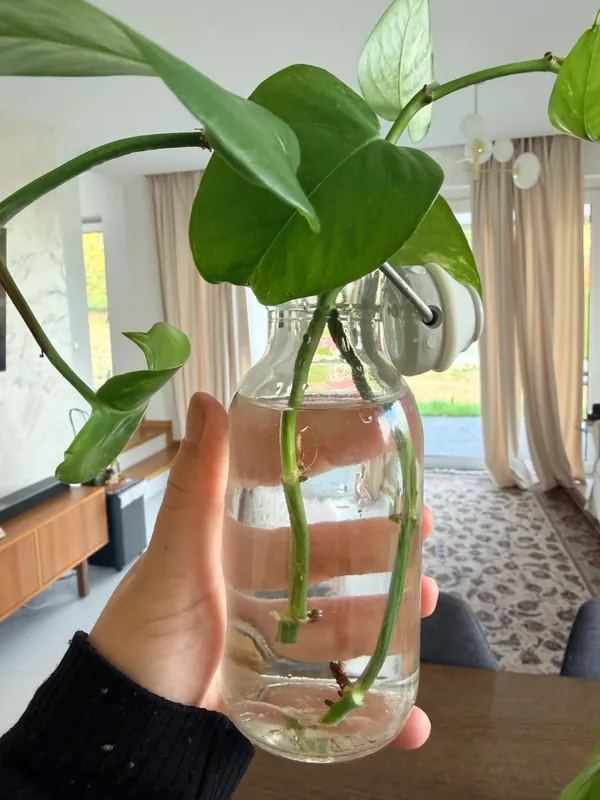
- Find the node. It's the point on the stem where the leaf grows, sometimes with a tiny root beside it. That's where the new roots come from.
- Cut just below a node, to get a piece 8 to 15 cm long with 2 or 3 leaves. Remove the lower leaves.
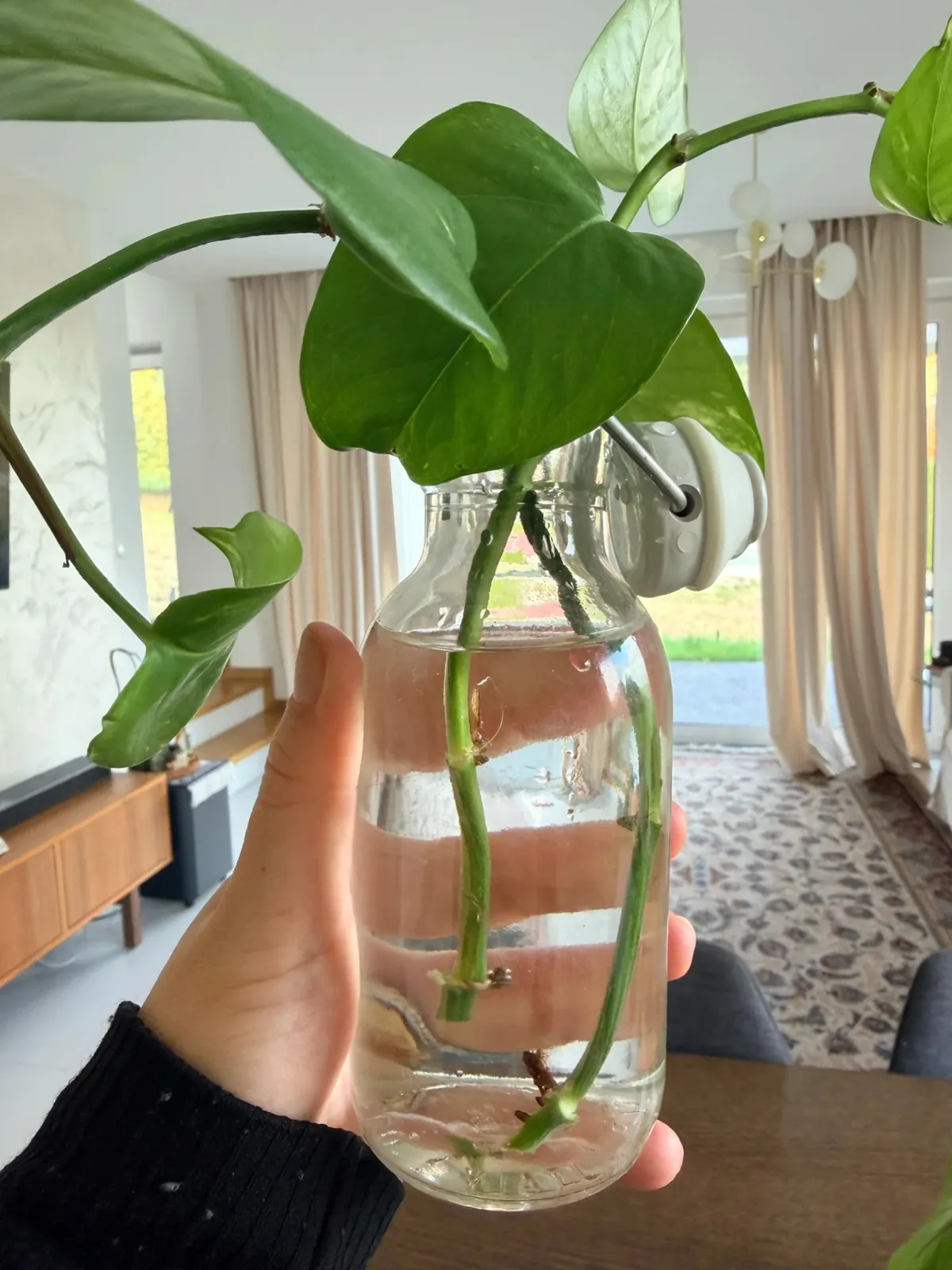
- Put it in water, with at least one node submerged and the leaves out. A leaf under water rots.
- Keep it in bright indirect light, with no direct sun on the glass. See bright indirect light: what it is.
- Change all the water every week, and sooner if it turns cloudy. Wash the glass at the same time. Standing water is a breeding ground for mosquitoes.
- Wait. Roots appear in 2 to 4 weeks. At about 5 cm long you can move the cutting to a pot, or leave it in water: pothos lives for years that way. See how to care for plants in water.
You can also plant it straight into soil
The same stem can go straight into damp soil. If you're moving it from the glass to a pot, keep the soil lightly damp for the first 2 to 3 weeks, without soaking it. Roots that grew in water are thinner and need some time to get used to soil.
What about ground cinnamon?
Many people dust ground cinnamon on the cut before planting in soil. Cinnamaldehyde, the main compound in cinnamon oil, has an antifungal effect proven in the lab. Kitchen cinnamon on the cut, though, has had little study, and there's no proof it makes roots come faster. If you want to use it, use only a little, just on a dry cut, and never on the leaves.
Take care with pets and skin
Pothos is toxic to dogs and cats (calcium oxalate) and the sap can irritate the skin. Wear gloves when cutting, keep the cuttings out of your pets' reach and, if yours chews one, see a vet.
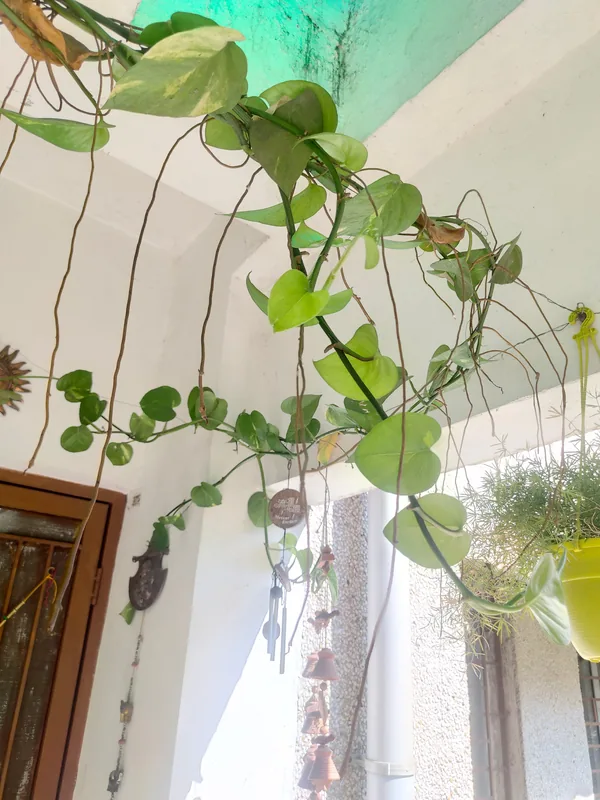 Plant in this guideDevil's ivySee the full plant page
Sources
- Pothos, ASPCA: https://www.aspca.org/pet-care/animal-poison-control/toxic-and-non-toxic-plants/golden-pothos
- Pothos, NC State Extension: https://plants.ces.ncsu.edu/plants/epipremnum-aureum/
- Plants in water, UVM Extension: https://www.uvm.edu/pss/ppp/articles/waterin.html
- Cinnamaldehyde as an antifungal: Jimenez et al., Antibiotics, 2024: https://doi.org/10.3390/antibiotics13111095 and OuYang et al., Frontiers in Microbiology, 2019: https://doi.org/10.3389/fmicb.2019.00055
- Cinnamaldehyde registered as a biological fungicide: EPA fact sheet (1998): https://www3.epa.gov/pesticides/chem_search/reg_actions/registration/fs_PC-040506_1-Oct-98.pdf
- Standing water and mosquitoes, Brazilian Ministry of Health: https://www.gov.br/saude/pt-br/assuntos/noticias/2025/novembro/dez-dicas-para-eliminar-focos-do-mosquito-da-dengue